The Science of Colliding Waves
Imagine jumping on a trampoline with a friend. If both of you bounce at the exact same time, you create a giant bounce that sends you flying into the air. But if you bounce at the wrong time, you end up stopping each other's momentum completely. This is exactly how waves act in real life! When two or more waves travel through the same space, they don't crash into each other like cars. Instead, they pass right through one another, secretly teaming up to share their energy. Scientists call this teamwork the Principle of Superposition. It basically means that at any single spot, the height of the final wave is just the two individual waves added together.
When these waves team up, they can pull off two very different tricks: constructive interference and destructive interference. Constructive interference happens when the waves are perfectly in sync, or "in phase." Think of it as the high point (crest) of a water wave meeting the high point of another water wave. They help each other out, building a giant super-wave! On your simulator screen, these are the brightly colored, flashing areas. These super-bounces are called antinodes, where the wave action is at its absolute peak.
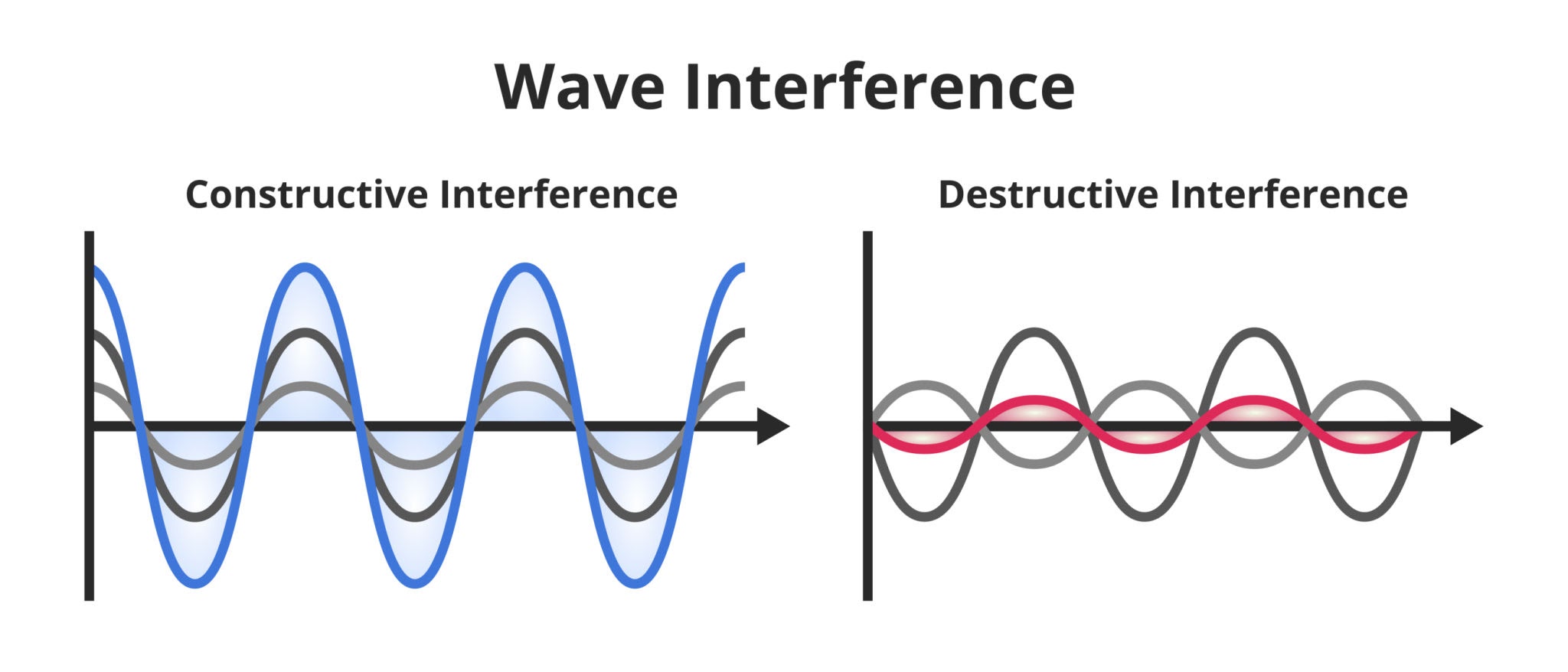
The second trick is destructive interference, and it is the exact opposite. This happens when the waves are completely out of sync, or "out of phase." Imagine the high point of one wave meeting the low point (trough) of another wave. The high hill falls into the low valley, completely flattening the water out! Because both of our wave machines are creating identical ripples, they cancel each other out to zero. These completely flat, quiet paths create the dark bands cutting through your screen. In physics, these frozen lines of stillness are called nodal lines.
When you click the "Run Simulation" button, you can watch these ripples start traveling and crashing into each other to create this awesome pattern. How this pattern looks depends a lot on two things you can control: wavelength and how far apart the sources are. Wavelength is just the distance from one wave hill to the next. If you use the slider to make the wavelength smaller (making the ripples tight and crowded), or if you slide the two sources further apart, you will see a lot more dark and bright lines packed into the screen!
This simple trick of overlapping ripples is actually one of the most important discoveries in science history. Back in 1801, a scientist named Thomas Young shone light through two tiny slits to see what would happen. He saw this exact same pattern of bright and dark lines on the wall, proving for the first time ever that light travels in waves! Today, the exact same math explains how noise-canceling headphones work (by making a "destructive" sound wave to cancel out background noise) and how internet data travels through space. Waves are everywhere, and they always follow these same beautiful rules.